Tur audio Sabile
10 obiective turistice
- Sumar tur audio
-
Sumar tur audio
Update Required To play the media you will need to either update your browser to a recent version or update your Flash plugin.Welcome to Sabile, a romantic town in Kurzeme, which is beautifully situated in the terrace-like landscape of the most picturesque and deepest section of the Abava River in the southern part of Talsi district. Sabile is first mentioned in historical records in 1253 when the Livonian Order and the Bishop of Kurzeme divided the Curonian lands. The town’s charm unfolds through the flowing Abava River, the scenic terrain, Wine Hill, iconic streets, and the facades of ancient buildings. The historical centre is an architectural monument of national significance, comprised of buildings from the 15th to the 19th century. The most architecturally valuable structures from the 19th century are located on Talsu-Street, Ventspils-Street, Rīgas-Street, and Kuldīgas-Street. There are several culturally and historically significant landmarks in Sabile, including the church building, organ, chancery, the former synagogue building, the hillfort, and the Brincken Chapel. Sabile obtained town status in 1917. One might wonder why it is called the town with the grape. Because its symbol is the historic Wine Hill, and grapes are also reflected in the town’s coat of arms. Currently, Sabile is home to around 1000 residents, with 80 percent being Latvians and 20 percent belonging to other ethnicities, including Slavic and Roma communities. Legend has it that Sabile takes its name from the sound of a ringing bell. Ther used to be a castle on the hillfort, and a chief lived there with his daughter. The father had set high demands for potential suitors, but one man managed to fulfil all the requirements. He married the daughter and began building a town. The first structure he erected in the town was the church, and a bell was brought from elsewhere. As they were descending the hill, the bell fell from the cart, rolled down, and rang out ‘Sa-bi-la! Sa-bi-la!’ And so the town was named Sabile.
- 1 The synagogue of Sabile
- 2 Mysteries of Sabile
- 3 The ‘Crooked Innkeeper’
- 4 The Sabile Church
- 5 Sabile Hillfort
- 6 17th century cannon
- 7 Photo Gallery of Sabile on Rīgas-Street
- 8 The Wine Hill of Sabile
- 9 The ‘Switzerland of Kurzeme’
- 10 Brincken Chapel
-
Sumar tur audio
Update Required To play the media you will need to either update your browser to a recent version or update your Flash plugin.Welcome to Sabile, a romantic town in Kurzeme, which is beautifully situated in the terrace-like landscape of the most picturesque and deepest section of the Abava River in the southern part of Talsi district. Sabile is first mentioned in historical records in 1253 when the Livonian Order and the Bishop of Kurzeme divided the Curonian lands. The town’s charm unfolds through the flowing Abava River, the scenic terrain, Wine Hill, iconic streets, and the facades of ancient buildings. The historical centre is an architectural monument of national significance, comprised of buildings from the 15th to the 19th century. The most architecturally valuable structures from the 19th century are located on Talsu-Street, Ventspils-Street, Rīgas-Street, and Kuldīgas-Street. There are several culturally and historically significant landmarks in Sabile, including the church building, organ, chancery, the former synagogue building, the hillfort, and the Brincken Chapel. Sabile obtained town status in 1917. One might wonder why it is called the town with the grape. Because its symbol is the historic Wine Hill, and grapes are also reflected in the town’s coat of arms. Currently, Sabile is home to around 1000 residents, with 80 percent being Latvians and 20 percent belonging to other ethnicities, including Slavic and Roma communities. Legend has it that Sabile takes its name from the sound of a ringing bell. Ther used to be a castle on the hillfort, and a chief lived there with his daughter. The father had set high demands for potential suitors, but one man managed to fulfil all the requirements. He married the daughter and began building a town. The first structure he erected in the town was the church, and a bell was brought from elsewhere. As they were descending the hill, the bell fell from the cart, rolled down, and rang out ‘Sa-bi-la! Sa-bi-la!’ And so the town was named Sabile.
Recenzii
Descărcați aplicația gratuită izi.TRAVEL
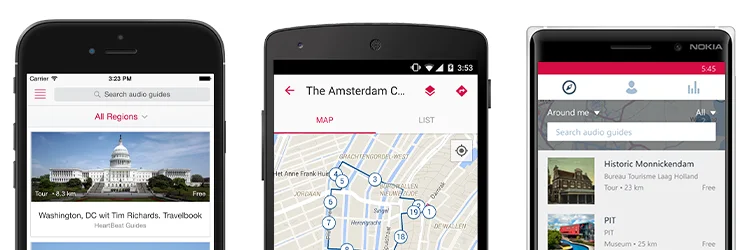
Creați-vă propriile tururi audio!
Folosirea sistemului şi a aplicaţiei ghid mobile este gratuită