“Eccentricity Manifesto”
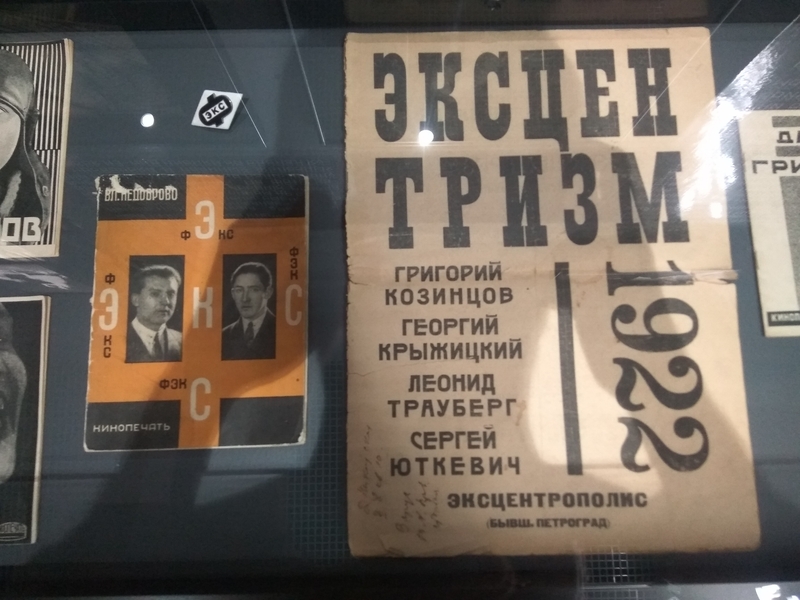
Young and innovative film directors created the new revolutionary Soviet cinema. Like most leading artists of revolutionary Russia, they were much into eccentricity. In front of you is one of the rarest editions the Museum of Cinema funded, the “Eccentricity Manifesto” booklet printed in 1000 copies on the 5th of December, 1921. (This particular copy belonged to Sergei Eisenstein.) The authors of the Manifesto, Grigory Kozintsev, Leonid Trauberg, Sergei Yutkevitch, and Georgy Kryzhitsky – “The Apostles of Eccentricity” as they called themselves, -- advocated on pages of the booklet for ‘art devoid of capital letters, pedestal, and fig leaf’, ‘hyperbolically rough, stunning, nerve-striking, overtly utilitarian, mechanically precise, instant, fast.’ For them, the ideal of eccentricity was ‘a chansonnette, Pinkerton, auctioneer’s call, street swearing. In painting, a circus poster, pulp fiction cover. In music, a jazz band, circus marches. In ballet – American cabaret dance. In theatre – music hall, cinema, circus, cabaret, boxing.’ Seven months following this publication, on July 9, 1922, Kozintsev and Trauberg declared foundation of the Factory of Eccentric Actors (or FEKS).
The FEKS badge that lies beside the Manifesto booklet belonged to Yanina Zheimo, a member of the FEKS group and an actress remembered by most Russians as Cinderella in the eponymous 1947 film.


Опубликуйте собственный аудиотур!
Используйте систему и мобильное приложение абсолютно бесплатно
