39 Sehenswürdigkeiten
- Audio-Tour Zusammenfassung
-
Audio-Tour Zusammenfassung
Update Required To play the media you will need to either update your browser to a recent version or update your Flash plugin.Title: Discovering Bucharest: A Melting Pot of History and Culture
Bucharest, the capital of Romania, is a city that captivates with its diverse and contrasting charm. Known as the "Little Paris of the East" in the 19th and early 20th century, Bucharest has grown into an eclectic mix of old and new, history and modernity, culture and innovation.
Embarking on a journey through Bucharest means diving deep into a rich tapestry of history. The city was first documented in the 15th century, and since then, it has seen numerous transformations. From the rule of Vlad Tepes, the inspiration for Bram Stoker's Dracula, to the communist-era under Nicolae Ceaușescu, and the subsequent 1989 revolution, Bucharest's history is as tumultuous as it is fascinating.
Among the main attractions in Bucharest, the Palace of the Parliament stands out. This colossal building, built during Ceaușescu's reign, is the second-largest administrative building in the world, after the Pentagon. Its colossal, ornate interior, filled with marble, crystal, and gold, is a stark reminder of Romania's communist past.
Another must-visit is the Village Museum, an open-air ethnographic museum located in Herastrau Park. The museum offers a glimpse into traditional Romanian village life with over 200 buildings from all over the country, including churches, workshops, and traditional homes.
The Old Town, known as Lipscani, is the heart of Bucharest's nightlife and a hub for art and culture. Here, you'll find car-free cobblestone streets lined with restaurants, bars, shops, and art galleries. In the middle of the Old Town stands the 18th-century Stavropoleos Monastery, an architectural gem that combines Romanian and Byzantine elements.
The Romanian Athenaeum, a neoclassical concert hall, is a symbol of the city's cultural life. Its lavishly decorated circular building hosts concerts, music festivals, and the George Enescu Philharmonic Orchestra.
Bucharest's cultural significance is deeply embedded in its vibrant arts scene. The city is home to numerous theaters, such as the National Theater and the Odeon Theater, and hosts a variety of festivals throughout the year, including the Bucharest International Film Festival and the George Enescu Classical Music Festival.
Literature enthusiasts can visit the Museum of Romanian Literature to explore the country's literary history, while art lovers can admire European and Romanian art at the National Museum of Art.
Visiting Bucharest is relatively straightforward. Henri Coandă International Airport serves as the main entry point, with flights from major European cities. The city has a well-developed public transportation system, including buses, trams, and a metro system. English is widely spoken by younger generations and in tourist areas, making communication easy for travelers.
Bucharest has a moderate climate, with hot summers and cold winters. The best time to visit is during spring (April-June) and fall (September-November) when the weather is pleasant and the city is less crowded.
With its blend of history, culture, and lively urban life, Bucharest offers an enriching experience for visitors. Whether you're tracing the city's history, exploring its vibrant arts scene, or simply enjoying its bustling cafes and parks, Bucharest promises a myriad of unforgettable experiences. - 1 "King Michael I" Park
- 2 Arcul de Triumf
- 3 "Dimitrie Gusti" National Village Museum
- 4 The House of the Free Press
- 5 "Ceaușescu" House
- 6 Monument to the Heroes of the Air
- 7 Grigore Antipa National Museum of Natural History
- 8 Știrbei Palace
- 9 Equestrian Statue of Carol I
- 10 The Romanian Athenaeum
- 11 Memorial of Rebirth
- 12 The New & Old Building
- 13 National Museum of Art
- 14 The Royal Palace of Bucharest
- 15 Kretzulescu Church
- 16 University Square
- 17 Suţu Palace
- 18 The Museum of Bucharest
- 19 Stock Exchange Palace
- 20 Macca - Villacrosse Passage
-
Audio-Tour Zusammenfassung
Update Required To play the media you will need to either update your browser to a recent version or update your Flash plugin.Title: Discovering Bucharest: A Melting Pot of History and Culture
Bucharest, the capital of Romania, is a city that captivates with its diverse and contrasting charm. Known as the "Little Paris of the East" in the 19th and early 20th century, Bucharest has grown into an eclectic mix of old and new, history and modernity, culture and innovation.
Embarking on a journey through Bucharest means diving deep into a rich tapestry of history. The city was first documented in the 15th century, and since then, it has seen numerous transformations. From the rule of Vlad Tepes, the inspiration for Bram Stoker's Dracula, to the communist-era under Nicolae Ceaușescu, and the subsequent 1989 revolution, Bucharest's history is as tumultuous as it is fascinating.
Among the main attractions in Bucharest, the Palace of the Parliament stands out. This colossal building, built during Ceaușescu's reign, is the second-largest administrative building in the world, after the Pentagon. Its colossal, ornate interior, filled with marble, crystal, and gold, is a stark reminder of Romania's communist past.
Another must-visit is the Village Museum, an open-air ethnographic museum located in Herastrau Park. The museum offers a glimpse into traditional Romanian village life with over 200 buildings from all over the country, including churches, workshops, and traditional homes.
The Old Town, known as Lipscani, is the heart of Bucharest's nightlife and a hub for art and culture. Here, you'll find car-free cobblestone streets lined with restaurants, bars, shops, and art galleries. In the middle of the Old Town stands the 18th-century Stavropoleos Monastery, an architectural gem that combines Romanian and Byzantine elements.
The Romanian Athenaeum, a neoclassical concert hall, is a symbol of the city's cultural life. Its lavishly decorated circular building hosts concerts, music festivals, and the George Enescu Philharmonic Orchestra.
Bucharest's cultural significance is deeply embedded in its vibrant arts scene. The city is home to numerous theaters, such as the National Theater and the Odeon Theater, and hosts a variety of festivals throughout the year, including the Bucharest International Film Festival and the George Enescu Classical Music Festival.
Literature enthusiasts can visit the Museum of Romanian Literature to explore the country's literary history, while art lovers can admire European and Romanian art at the National Museum of Art.
Visiting Bucharest is relatively straightforward. Henri Coandă International Airport serves as the main entry point, with flights from major European cities. The city has a well-developed public transportation system, including buses, trams, and a metro system. English is widely spoken by younger generations and in tourist areas, making communication easy for travelers.
Bucharest has a moderate climate, with hot summers and cold winters. The best time to visit is during spring (April-June) and fall (September-November) when the weather is pleasant and the city is less crowded.
With its blend of history, culture, and lively urban life, Bucharest offers an enriching experience for visitors. Whether you're tracing the city's history, exploring its vibrant arts scene, or simply enjoying its bustling cafes and parks, Bucharest promises a myriad of unforgettable experiences.
Bewertungen
Noch keine Bewertungen
Erste Rezension schreiben- Noch keine Bewertungen. Seien Sie der Erste, der eine Bewertung abgibt!
Kostenlose izi.TRAVEL-App herunterladen
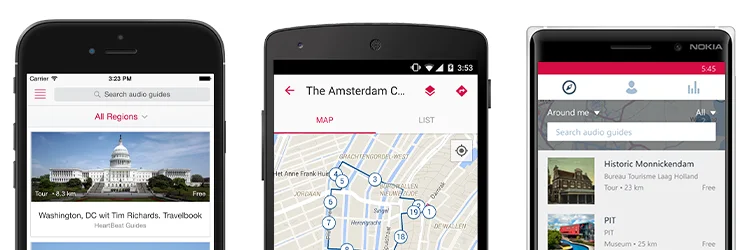
Erstellen Sie Ihre eigenen Audio-Touren!
Die Verwendung des Systems und der mobilen Stadtführer-App ist kostenlos.