1st Stop Locust Point Walkway & Pier, Immigrant Entry Point
Background: Most of Baltimore's Jewish community in the 19th and most of the 20th century can trace their lineage to immigrant forebears who arrived from Eastern and Central Europe via ships docked at Locust Point. The pier at Locust Point with its small immigrant memorial park and new wood boardwalk is at the southern edge of Baltimore’s harbor. This was where my great-grandparents Chaim and Sura Bluma Shapiro, arrived via steamship, in steerage, around 1904. They came from Lithuania, which is where a sizable portion of the local immigrant Jewish population hailed from at the turn of the last century. Jews made up a significant percentage of the millions of immigrants from Europe who disembarked at Locust Point between the late 1860s, just after the Civil War, until the 1910s, just after World War I. This port of entry was second only to New York’s Ellis Island in the number of immigrants who arrived here. And for observers of the time, Baltimore’s was the superior and more humane environment for new immigrants, since doctors boarded the ships at the Baltimore dock (rather than penning them in a prison-like holding pen, as was done at Ellis Island) to inspect the immigrants and approve of their entry. Many of the new arrivals only stopped briefly at the port before continuing their journeys to Midwestern cities on the B & O Railroad whose train tracks are still used today directly behind the Locust Point pier, in what is now the Under Armour manufacturing campus. If you drive here, you will have seen and crossed these railroad tracks.
Features: One of the most striking aspects of the Locust Point pier is that it features open views of the whole harbor, with hundreds of boats docked on the other side, and boats and ships busily going across the water. The wooden walkway or boardwalk just along the water to the left of the small parking area at the water taxi dock (or to the right of you as you get off the water taxi/boat), is pristine and new. There are restful new benches on it, and a small athletic field just behind it, all built and maintained by major sports clothing manufacturer Under Armour, whose factory campus and employee gym now abuts the historic pier. The fact that Under Armour has taken over the area is a profound change for the better in what had become a deserted former manufacturing center after the steel plant closures of the 1980s, and is now a brightly refurbished and growing area employing thousands with new jobs that are infusing the local economy with new resources. This is in some ways fitting, given how many of the immigrants who first arrived at this pier were coming to work at factories of many kinds, and were very hard workers. Their sweat and effort made it possible for the next generation to get educations unheard-of in the "old country." This is a familiar American story, common to many immigrant families, past and present. Turning to your left, with the water directly behind you, you'll see a small, plain, concrete immigrant memorial park area with a small plaque summarizing the history of this immigrant disembarkation point.
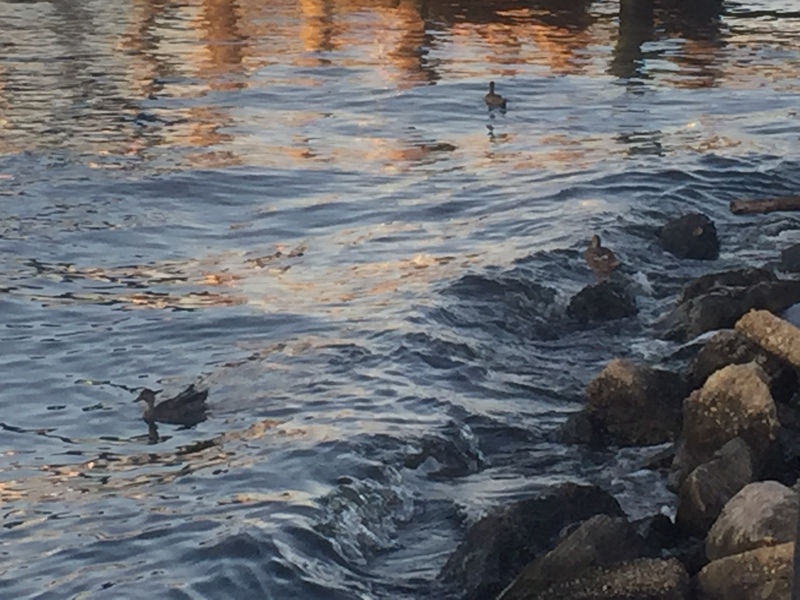
Transportation: to get to Locust Point pier, by car: drive down the Key Highway south and then east (curving around with the harbor, keeping the water to your left), and then make a Left on Hull Street all the way to its dead-end at the water just past the Under Armour factory buildings to your left, and several big water towers to your right. [NOTE: your GPS may say "Tide Point" if you haven't zoomed in close enough, instead of "Locust Point," but it's the same place.] Or you can take a BMT Yellow Route water taxi/Harbor Connector boat from the "Rusty Scupper" restaurant at the Inner Harbor to Locust Point. [NOTE: MTA public transit print & online maps don't show Locust Point, they stop just below the inner harbor; GPS shows it well, though.] This spot is a great place for pictures, good for kids of all ages (though keep little ones close by; the harbor is not shallow). Ducks swim on the water near the water taxi/boat gangplank. The water towers to your right as you face the water (or to your left as you disembark from the water taxi/boat) are adorned with huge paintings of major sports figures from Baltimore, great Olympian Michael Phelps, baseball legend Cal Ripken, and others.
Timing: Getting to the Locust Point stop is about a 15-20 min. drive from the Inner Harbor down Key Highway (avoiding rush hour 7-9 AM or 4-6 pm, if at all possible, which adds 30-60 mins. of waiting time in traffic) or a 5-10 min. ride from Rusty Scupper on the BMT Yellow Route water taxi/Harbor Connector boat. If you're walking from the Harborplace area, getting to the Rusty Scupper on foot is about a 10-15 min. walk. I'd plan on spending about 20-30 mins. at the pier.
Téléchargez l'appli gratuite izi.TRAVEL
- Télécharger sur l'App Store
- Application Android sur Google Play
- Télécharger depuis la boutique de téléphones Windows
Créez vos propres visites audio!
L'utilisation du système et de l'appli de guide mobile est totalement gratuite